
Collection: Air Pillows & Water Tubes
-
GLI 4' x 4' Winter Air Pillow, Ice Equalizer for Above Ground Pools, 500404AP
Vendor:GLI Pool Products
500404APRegular price $20.80Regular priceUnit price per$44.30Sale price $20.80 -
GLI 4' x 8' Winter Air Pillow, Ice Equalizer for Above Ground Pools, 500408AP
Vendor:GLI Pool Products
500408APRegular price $34.40Regular priceUnit price per$71.00Sale price $34.40 -
GLI 4' x 15' Winter Air Pillow, Ice Equalizer for Above Ground Pools, 500415AP
Vendor:GLI Pool Products
500415APRegular price $52.40Regular priceUnit price per$106.10Sale price $52.40 -
Swimline 4' x 4' Winter Air Pillow, Ice Equalizer for Above Ground Pools, WP44
Vendor:Swimline
WP44Regular price $18.50Regular priceUnit price per$38.10Sale price $18.50 -
Swimline 4' x 5' Winter Air Pillow, Ice Equalizer for Above Ground Pools, WP45
Vendor:Swimline
WP45Regular price $19.60Regular priceUnit price per$41.10Sale price $19.60 -
Swimline 4' x 8' Winter Air Pillow, Ice Equalizer for Above Ground Pools, WP48
Vendor:Swimline
WP48Regular price $26.50Regular priceUnit price per$55.80Sale price $26.50 -
Swimline 4' x 15' Winter Air Pillow, Ice Equalizer for Above Ground Pools, WP415
Vendor:Swimline
WP415Regular price $46.50Regular priceUnit price per$90.90Sale price $46.50 -
Pool Pillow Pal Air Pillow Centering Kit for Winter Pool Covers, POOLPILLOWPAL
Vendor:Pool Pillow Pal
POOLPILLOWPALRegular price $19.40Regular priceUnit price per$42.10Sale price $19.40 -
GLI Heavy Duty 8' Double Chamber Water Tube, Black for In Ground Winter Covers, 500008WTDHDBLK
Vendor:GLI Pool Products
500008WTDHDBLKRegular price $26.20Regular priceUnit price per$50.70Sale price $26.20 -
Swimline 10' Single Chamber Water Tube, Black for In Ground Winter Covers, 500010WTSHDBLK
Vendor:Swimline
500010WTSHDBLKRegular price $21.30Regular priceUnit price per$43.20Sale price $21.30 -
Swimline Heavy Duty 8' Double Chamber Water Tube, Blue for In Ground Winter Covers, VWT8D20
Vendor:Swimline
VWT8D20Regular price $25.40Regular priceUnit price per$48.60Sale price $25.40 -
Swimline Heavy Duty 10' Double Chamber Water Tube, Blue for In Ground Winter Covers, VWT10D20
Vendor:Swimline
VWT10D20Regular price $28.30Regular priceUnit price per$55.10Sale price $28.30 -
Swimline 8' Single Chamber Water Tube, Blue for In Ground Winter Covers, VWT820
Vendor:Swimline
VWT820Regular price $19.70Regular priceUnit price per$42.20Sale price $19.70 -
Swimline 10' Single Chamber Water Tube, Blue for In Ground Winter Covers, VWT1020
Vendor:Swimline
VWT1020Regular price $21.90Regular priceUnit price per$44.80Sale price $21.90 -
Swimline 10' Double Chamber Water Tube, Blue for In Ground Winter Covers, VWT10D
Vendor:Swimline
VWT10DRegular price $27.10Regular priceUnit price per$51.70Sale price $27.10 -
Swimline 8' Double Chamber Water Tube, Blue for In Ground Winter Covers, VWT8D
Vendor:Swimline
VWT8DRegular price $24.30Regular priceUnit price per$48.50Sale price $24.30


Winter Pool Air Pillows & Water Tubes
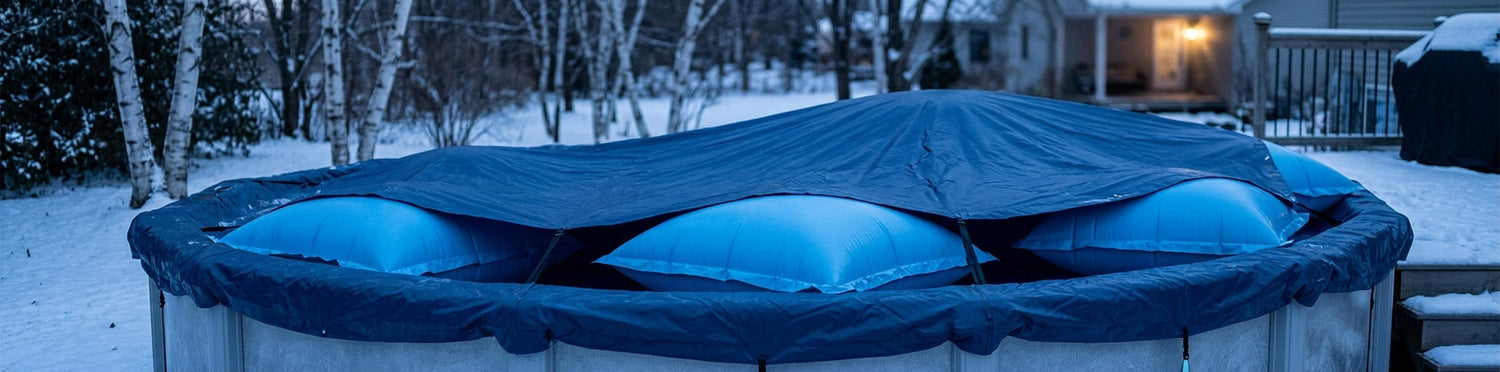
Ice does not damage a pool by being cold — it damages it by expanding sideways with nowhere to go. Winter pool air pillows and water tubes are how you manage that force. A pillow floats in the middle of an above ground pool and gives expanding ice a compressible target; water tubes ballast the edge of an inground cover so wind cannot lift it. PST Pool Supplies carries both from GLI, Swimline, and Pool Pillow Pal.
Air pillows — often labeled ice equalizers — come in 4' x 4', 4' x 5', 4' x 8', and 4' x 15' sizes from GLI and Swimline. Size to your pool: a 4' x 4' suits pools up to about 18' round, 4' x 8' covers most 21'–24' pools, and 4' x 15' is for larger or oval installations. Inflate to roughly 50–60% capacity, not drum-tight; a soft pillow compresses when ice pushes and a hard one just bursts. The Pool Pillow Pal centering kit solves the perennial problem of the pillow drifting to one side by midwinter. GLI publishes full sizing specs at GLI Pool Products.
Water tubes hold a solid inground winter cover down along the deck without drilling anchors. We stock 8' and 10' lengths in single chamber and double chamber, standard and heavy duty, in blue and black. Double chamber tubes are worth the small upcharge — if one baffle splits, the other still holds water and the tube stays put instead of ending up in the pool. Fill each tube only about two-thirds full so there is room for the water inside to freeze and expand. Pair tubes with an inground winter cover, or pillows with an above ground winter cover, and add a cover pump to keep meltwater off the top. Swimline's full winter line is at Swimline.
Order winter pool air pillows and water tubes with your cover so everything goes on in one trip — and buy one spare pillow, because the one that survives the whole winter is the exception, not the rule.